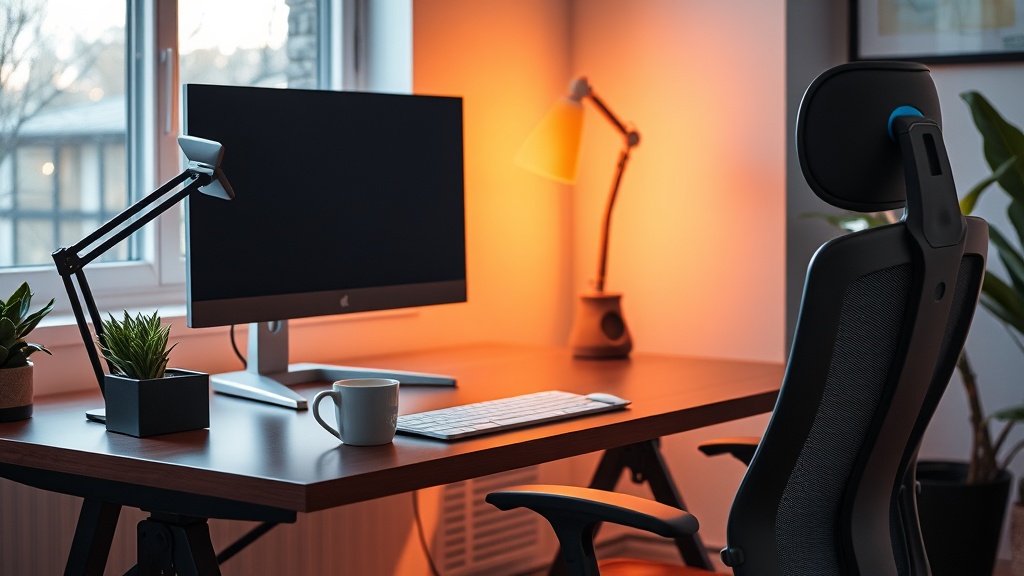
Build a Bio‑Harmony Home Office: Lighting & Ergonomic Hacks

Hook
Ever feel like your home office is a productivity black hole? I was stuck in a cycle of late‑night caffeine binges, eye strain, and missed deadlines—until I rewired the space to work with my body’s natural clock.
Context
Freelancers wear every hat: designer, accountant, marketer. The office you build isn’t just a desk; it’s the nervous system that keeps you sane and solvent. Aligning that space with your circadian rhythm—what I call bio‑harmony—means you work when you’re naturally sharp and rest when your brain is primed for sleep.
What You’ll Need
| Category | Items | Why it matters |
|---|---|---|
| Lighting | Adjustable LED panel (tunable color temperature), smart plug, light‑meter app | Controls melatonin suppression & alertness (ScienceDirect study) |
| Furniture | Ergonomic chair with lumbar support, height‑adjustable desk, anti‑fatigue mat | Reduces musculoskeletal strain that drags energy levels |
| Tech | Dual‑monitor arm, dark‑mode enabled laptop, blue‑light filter glasses | Keeps visual fatigue low and lets you switch focus quickly |
| Software | Pomodoro timer, task‑blocking app (e.g., Freedom), calendar with “focus blocks” | Turns the physical set‑up into a workflow system |
| Personal | Black coffee mug, water bottle, a small plant | Tiny cues that signal “work mode” |
Step‑by‑Step Blueprint
1. Map Your Natural Energy Peaks
Question: When am I most alert during the day?
- Action: Track your energy for a week using a spreadsheet or habit‑tracking app. Mark the hour you feel most focused and the hour you feel drained.
- Result: Most freelancers hit a “focus window” between 9 am‑12 pm and a dip around 2 pm.
2. Install Circadian‑Tuned Lighting
Question: How does lighting affect my bio‑harmony?
- Action: Mount a tunable LED panel above your desk. Set it to cool, high‑CCT (≈ 6500 K) during your primary focus window and warm, low‑CCT (≈ 2700 K) after 5 pm. Automate the schedule with a smart plug or the panel’s app.
- Evidence: A long‑term study showed fluctuating light profiles increased melatonin secretion ~1.5× versus static lighting, improving sleep quality and next‑day alertness¹.
3. Optimize Ergonomics for the Clock
Question: Why does posture matter for my circadian rhythm?
- Action:
- Position the monitor top edge at eye level; screen ~20‑30 in away.
- Keep keyboard and mouse at elbow height, forearms parallel to the floor.
- Use a lumbar‑support pillow and keep feet flat or on a footrest.
- Result: Proper posture reduces cortisol spikes that can disrupt sleep‑wake cycles.
4. Sync Work Blocks with Light
Question: What’s the ideal work‑break cadence?
- Action: Run a Pomodoro timer (25 min work, 5 min break). Align the first two Pomodoros with cool light, then switch to warm light for the final session of the day.
- Tip: During breaks, step away from the screen and look at a window or a green plant. Natural light reinforces the circadian cue.
5. Automate “Do‑Not‑Disturb” Signals
Question: How can I protect focus without constant self‑policing?
- Action: Use a task‑blocking app to mute social media and email from the start of your focus window until you switch to warm light. Set your calendar status to “Busy — Deep Work”.
- Result: Fewer interruptions keep the brain in a high‑beta state, which pairs well with the alerting effect of cool light.
6. Close the Day with a “Wind‑Down” Ritual
Question: What should I do after the warm‑light phase?
- Action: At 5 pm, dim lights to ≤ 200 lux, turn off the monitor, and switch to a low‑blue‑light reading lamp. Spend 10 min reviewing tomorrow’s tasks, then write a quick gratitude note.
- Science: Low‑lux, warm lighting signals melatonin release, prepping the body for sleep (Harvard Health, 2024).
Pro Tips
- Blue‑Light Glasses: Wear after 7 pm if you must use a screen; they block the 460 nm wavelength that suppresses melatonin.
- Dynamic Color Temperature: Enable “sunrise‑sunset” mode on your LED panel for a gradual shift that mimics natural daylight.
- Micro‑Movement Breaks: Every hour, stand, stretch, or do a 30‑second calf raise. Small movement spikes blood flow and counters the sedentary slump that drains energy.
Common Mistakes & Fixes
| Mistake | Why it hurts | Fix |
|---|---|---|
| Static lighting all day | Keeps melatonin suppressed, leading to insomnia and afternoon crashes. | Use a timer or smart app to shift color temperature. |
| Desk too low/high | Forces neck flexion or extension, raising cortisol. | Adjust desk height so elbows are at 90° and monitor at eye level. |
| Skipping the wind‑down | Blue‑light exposure after 8 pm delays sleep onset. | Set an alarm for “lights off” and stick to it. |
| Ignoring natural light | Indoor light can’t fully replace sunlight’s spectrum. | Open blinds for at least 15 min each morning; place a plant near the window. |
| Over‑loading the Pomodoro | 25‑min blocks can feel too short for deep creative work. | Switch to 50‑min work / 10‑min break for tasks that need immersion. |
Wrap‑Up
Your home office isn’t just furniture; it’s a bio‑harmony engine that can either drain you or power you through the freelance grind. By mapping your energy peaks, installing tunable lighting, tightening ergonomics, and automating focus blocks, you’ll work with your body’s clock instead of fighting it.
Next step: Grab a cheap tunable LED panel (you can find reliable options for under $80 on Amazon) and start the 7‑day trial outlined above. Track your sleep quality with a free app like Sleep Cycle and compare the numbers—your productivity will thank you.
Related Reading
- Spring Tech Detox: Unplug, Reconnect with Nature for Bio‑Harmony — A broader look at tech‑free habits that complement a bio‑harmonized workspace.
- Daylight Saving Time Reset: How to Reboot Your Circadian Rhythm for Better Sleep and Productivity — Fine‑tune your clock when the seasons change.
- The Scope Creep Kill Switch: A 4‑Step System That Recovered $8,000 in My First Year — Keep project overload from sabotaging your newly‑aligned workflow.
FAQ (Rich Snippet)
{
  "meta": {
    "faqs": [
      {
        "question": "What color temperature should I use for morning focus?",
        "answer": "Set your LED panel to a cool, high‑CCT (≈ 6500 K) during your primary focus window to boost alertness."
      },
      {
        "question": "How often should I adjust my desk height?",
        "answer": "Adjust it once when you change monitor size or chair; the ideal is elbows at 90° and screen eye‑level."
      },
      {
        "question": "Do blue‑light glasses really help after sunset?",
        "answer": "Yes—they block the 460 nm wavelength that suppresses melatonin, helping you fall asleep faster."
      },
      {
        "question": "Can I use a cheap LED strip instead of a panel?",
        "answer": "A tunable LED strip works if it offers color‑temperature control and at least 300 lux at the desk surface."
      },
      {
        "question": "What’s the best Pomodoro length for deep work?",
        "answer": "Try 50 min work / 10 min break for tasks that need sustained concentration; switch back to 25/5 for routine work."
      }
    ]
  }
}
Sources
- “A long‑term evidence‑based study of circadian rhythm‑oriented control strategies for office luminous environments.” ScienceDirect, 2025. https://www.sciencedirect.com/science/article/abs/pii/S0360132325010844
- Harvard Health Publishing. “Light exposure and sleep: How to set your bedroom for better rest.” 2024. https://www.health.harvard.edu/staying-healthy/light-exposure-and-sleep
- Frontiers in Photonics. “Lights should support circadian rhythms: evidence‑based scientific consensus.” 2023. https://www.frontiersin.org/articles/10.3389/fphot.2023.1272934/full