The 72-Hour Invoice Recovery Protocol: How to Get Paid Without Begging

Title: The 72-Hour Invoice Recovery Protocol: How to Get Paid Without Begging
Every freelancer eventually has that client who says, "almost done transferring" on a Friday at 4:55 PM, then sends three unrelated messages over the weekend and still pays nothing for two weeks.
You don’t need to be easier at getting paid. You need to be less improv-ready.
I used to think late payments were just one of those unlucky freelancer myths you learn to survive emotionally. Then I realized they’re a systems failure you create in your own process. If your payment flow depends on hope, you are running a business with a blindfold on.
Here’s the blunt version:
- Late payments are a cash-flow risk.
- Late payment risk is a policy risk.
- If a policy is vague, clients will test it.
No surprise there. The surprise is how often solo freelancers still wait until day 21 before they act like the money has a due date.
So here is a protocol that actually stops late-pay loops.
Why 72 hours, not 72 days
When an invoice is overdue, speed matters. The longer you let silence stretch, the more “exception” becomes the new default. For a lot of clients, delayed chasing signals that urgency is optional.
This protocol is simple and short:
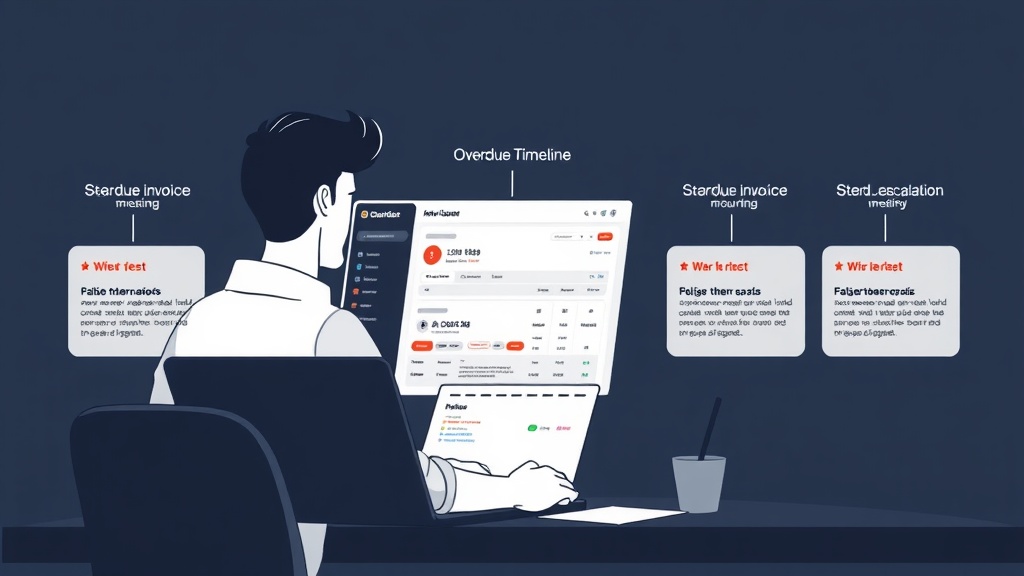
- Day 0 (due date): Send no-drama reminder with invoice number and exact amount.
- Day 2: Send concise follow-up with late-fee trigger date.
- Day 5: Send one firm escalation + payment options.
- Day 8+: Add written escalation path (formal demand, collections options, possible legal route).
Three touches. Same script style. No melodrama.
I’m giving you this because I used to be the same freelancer who wrote poetic justifications at 9 PM. Didn’t work.
Phase 1: Hard contract, soft ego
Most freelancers ask why this gets better and the answer is always before delivery.
Before you accept a new client:
- Put invoice due date in writing.
- Specify grace period (if any).
- Declare late fee and calculation method.
- Specify payment channels and who can approve delays.
You can still be polite and still have exact terms.
I’m not inventing this from scratch. Most billing guides for freelancers treat late fees as optional; it’s not. FreshBooks’ invoicing guidance recommends late fees be clearly written into contract terms and invoices, and calls out that most freelancers keep around 1%–2% monthly; they call 1.5% monthly common practice when legally allowed. Source.
If you’re thinking “this sounds aggressive,” good. It is not. It is unambiguous.
Phase 2: The message stack (copy/paste ready)
Reminder 1 — Day 0: Neutral
Subject: Invoice due reminder — [Invoice #]
Hi [Name],
Quick reminder that invoice [#] for [amount] is due today.
If you’ve already paid, ignore this message. If not, send the payment confirmation and I’ll mark it cleared right away.
Best,
[Your name]
Reminder 2 — Day 2: Boundary set
Subject: Invoice due reminder #2 — [Invoice #]
Hi [Name],
I’m following up on invoice [#] for [amount], which is now [X] days overdue.
As written in our agreement, late fees will begin at [rate] starting [date].
I can hold this at today’s amount if I get confirmation of payment today.
Best,
[Your name]
Escalation — Day 5: Non-negotiation options
Subject: Payment plan or paid status needed by [Date]
Hi [Name],
Invoice [#] is now [X] days overdue.
Please choose one of these options by [deadline]:
- Full payment today.
- Confirm a payment of at least [X%] today and the balance on [date].
- Written objection with dispute details in one sentence so we can decide next steps.
If I don’t receive one of the options, I will proceed with the collection steps in our contract.
[Your name]
That’s all. Every word matters.
Why this works
You’re doing three things at once:
- Protecting your margin: your fee is yours.
- Reducing uncertainty: client no longer controls timeline.
- Documenting for escalation: every message proves you acted in sequence.
This is the same method I use when I onboard projects that can’t tolerate cash shock. I don’t want a fight; I want a date.
What about the “legal” bit?
People love pretending freelancers should never threaten action because that sounds harsh. It doesn’t sound harsh to do things the same way every time.
The FTC’s FDCPA rules are written for debt collection practices and include strong language limits if you move into collection behavior (harassment, threats, false statements, unclear timing, etc.). I’m not trying to give legal advice here, but if your process ever becomes collection-style, those guardrails are why clear, factual communication matters. Here is the framework from the federal text in plain language:
- Don’t threaten actions you won’t actually take.
- Don’t pretend fees are something you can’t legally enforce.
- Don’t turn follow-up into harassment.
- Keep every contact factual and documented.
You can read it here: FTC FDCPA text.
I only mention this because freelancers often get sloppy and then get defensive. Your communication style should be calm, not combative. It still works.
Phase 3: The legal escalation ladder
No one wants to hear “small claims” in week one. That’s fine. It doesn’t belong there.
But by day 8 you should have a plan:
- Option A: Revised invoice with late fees.
- Option B: Demand letter template (one-paragraph, no extra drama).
- Option C: Formal collections or legal route.
If the client is silent and small claims is next, you do not need to wait for permission. You need a file:
- Contract/work agreement
- Invoices
- Payment reminders and timestamps
- Delivery confirmation
Your proof stack does the talking.
The math that makes this boring (and useful)
If your late fee is 1.5% monthly and the invoice is $2,000, your first-month late fee is:
2000 x 0.015 = 30
Add $30. That is not your only win. The win is that clients start paying before they calculate that fee or before you pass day 8. You’re not making money on the fee; you’re enforcing payment discipline.
The two decisions that save you from 3 AM panic
Decision 1: Don’t send mixed messages.
If your terms say 30 days, don’t ask for payment after 12 days in one line and threaten after 35. Your own language must be consistent.
Decision 2: Don’t let one bad client reset your standards.
You can offer one exception, but never at the cost of your policy. A solo business is a stack of small promises. Break one promise repeatedly, and your whole stack collapses.
Before you publish your next invoice, do this 3-step checklist
- Add payment terms to contract and SOW.
- Add the same terms to invoice template.
- Set three automatic reminders on Day 0, 2, and 5.
If those are not done, your invoice process is still guessing.
I don’t want your business to be lucky with payments. I want it to be repeatable.
Now go lock your policy down and stop hoping.