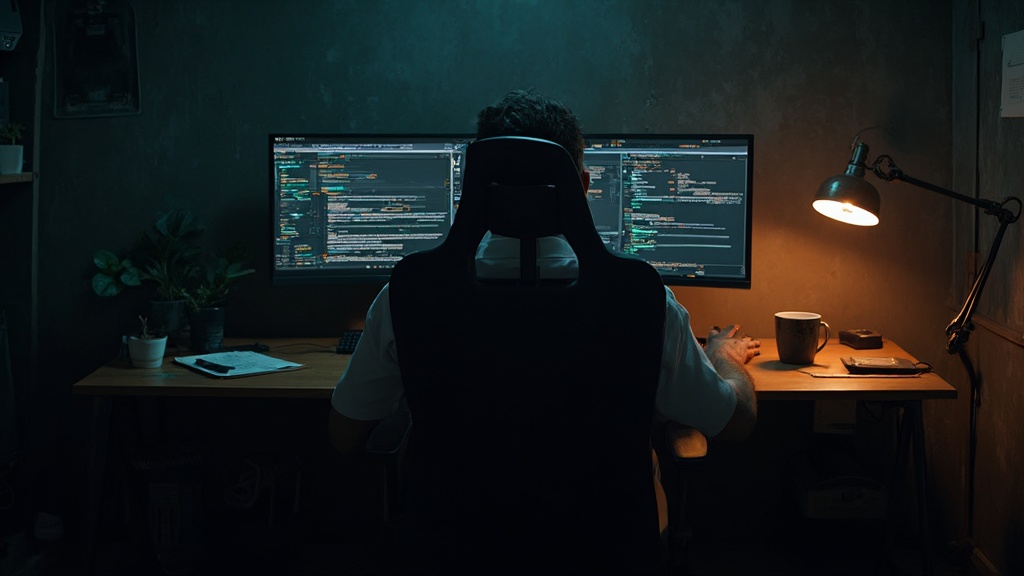
The 'Digital Nomad' Lie: Why Working From Paradise Will Bankrupt Your Business
Look, I Tried the Beach Office. It Was a Disaster.
In 2017, I spent three weeks in Tulum, Mexico. You know the photos—the turquoise water, the palapa roof, the MacBook perfectly angled to catch that golden hour glow.
I got exactly 11 billable hours done in 21 days. The rest? Sunburn. Sand in my keyboard. A client who couldn't reach me because the Wi-Fi dropped every 17 minutes. And a $4,200 hole in my revenue that took me four months to dig out of.
Let me be brutally clear: The "digital nomad" lifestyle is a marketing funnel designed to sell you coworking memberships and overpriced coconut smoothies. It is not a business strategy. And if you're treating it like one, you're not running a business—you're funding a vacation with your savings account.
The Math Doesn't Work (And I've Done It)
Here's what the Instagram posts don't show you:
- Time zone chaos: Your clients in Chicago need you at 2 PM their time. That's 3 AM in Bali. Guess who loses that negotiation?
- Connectivity tax: "High-speed internet" in most nomad hotspots means 8 Mbps down on a good day. Try screensharing your Figma prototype on that.
- The distraction premium: Studies (and my own miserable experience) show that context-switching between "vacation mode" and "work mode" costs you 40% of your cognitive capacity. At my $125/hour rate, that's $50 per hour I'm lighting on fire.
- Hidden infrastructure costs: Coworking space: $200/month. Portable hotspot backup: $150/month. Coffee shop tabs because you feel guilty camping a table for 6 hours: $400/month.
That's $750/month in overhead to work worse than you would at home.
"But Marcus, I Need Inspiration!"
No. You need a chair that supports your lumbar spine and a door that locks.
I spent 11 years in agency life. The best work I ever produced happened in a gray cubicle with flickering fluorescent lights. Not because the environment was inspiring, but because it was consistent. My brain knew: Chair = work mode. Standing desk = break mode. The ritual is what produces the output, not the view.
(Fun fact: I have a window in my current office. I keep the blinds closed 90% of the time. The outside world is a distraction. The work is inside.)
What I Actually Need to Do My Job
After Tulum, I built a "Remote Work Requirements" checklist. I don't go anywhere that doesn't meet all five:
- Ergonomics: A desk at the correct height, an ergonomic chair, and an external monitor at eye level. No exceptions. Working from a kitchen table destroys your body in six months.
- Connectivity redundancy: Primary connection must be 50+ Mbps down / 10+ up. Backup 4G/5G hotspot with local SIM. I've walked away from Airbnbs that couldn't provide this.
- Time zone alignment: I stay within three hours of my primary clients. Period. The 12-hour Asia flip works for async teams, not for solo operators who need to get on calls.
- Quiet: Not "tropical ambience with crashing waves." Silence. Construction noise, roosters, and hostel parties are not "authentic local flavor"—they're billable-hour killers.
- A door that locks: Separation between work and life. If I can see my bed from my desk, I'm working from bed by day three. We both know it.
Guess how many "digital nomad hotspots" check all five boxes? Almost none. And the ones that do cost as much as Chicago rent.
The Real Flex Isn't the Location
Here's what I post on Instagram now: A photo of my Friday afternoon net worth calculation. A spreadsheet with green numbers. A signed contract with a 50% deposit clause.
That's the real freedom. Not working from a hammock. Having enough money in the bank that I could buy a hammock store if I wanted to—but choosing to work because my business is healthy and my clients respect me.
The "digital nomad" aesthetic is performative. It's a hustle-culture costume. It says: "Look at me, I escaped the corporate grind!" while quietly panicking about how to pay for the next visa run.
The real escape? A business that prints money whether you're in Bali or Bridgeport.
The One Time Remote Work Makes Sense
I'm not anti-travel. I'm anti-delusion.
Last year, I spent two weeks working from my sister's guest room in Denver. Why it worked:
- Same time zone as my Chicago clients
- She has an ergonomic setup (she's a developer—we're a weird family)
- Fiber internet
- Door that locks
- I worked 8 AM – 4 PM, then spent evenings with family. No "work a little, explore a little" chaos.
That's not digital nomadism. That's just… having a functional laptop and boundaries. The location was irrelevant to my output.
What to Do Instead
If you're currently scrolling through #VanLife posts while sitting in a Starbucks, here's your action plan:
1. Calculate your true hourly rate. If you don't know it, you're not ready to optimize for location. (Total annual revenue ÷ total billable hours. Include admin time. Be honest.)
2. Audit your current setup. How many hours of deep work do you get per day? If it's less than four, a beach view won't fix it. Your systems are broken.
3. Build a location-independent business, not a lifestyle. This means: recurring revenue, solid contracts, automated onboarding. If you need to be "present" to make money, you're not free—you're just working remotely.
4. Take actual vacations. Two weeks. No laptop. Paid for by the business, not your emergency fund. That's the real luxury—not working from a cabana, but being able to not work from a cabana.
The Bottom Line
I have a physical "Wall of Shame" in my office. Among the bounced checks and bad contracts is a photo from Tulum: me, sunburned, holding a frozen laptop that had sand in the fan.
Underneath it, I wrote: "This is what 'freedom' looks like when you confuse aesthetics with infrastructure."
A sustainable freelance business isn't about where you work. It's about systems that work whether you're motivated or not, inspired or not, in paradise or in a windowless room. The goal isn't to escape your desk—it's to build a desk so functional you don't want to escape it.
Now close the travel blogs and go fix your onboarding process. That's where your freedom lives.
Marcus Vance is a UI designer and freelance operations consultant based in Chicago. He has never worked from a beach successfully and sees no reason to try again. The coffee is always black, and the blinds are always closed during deep work.