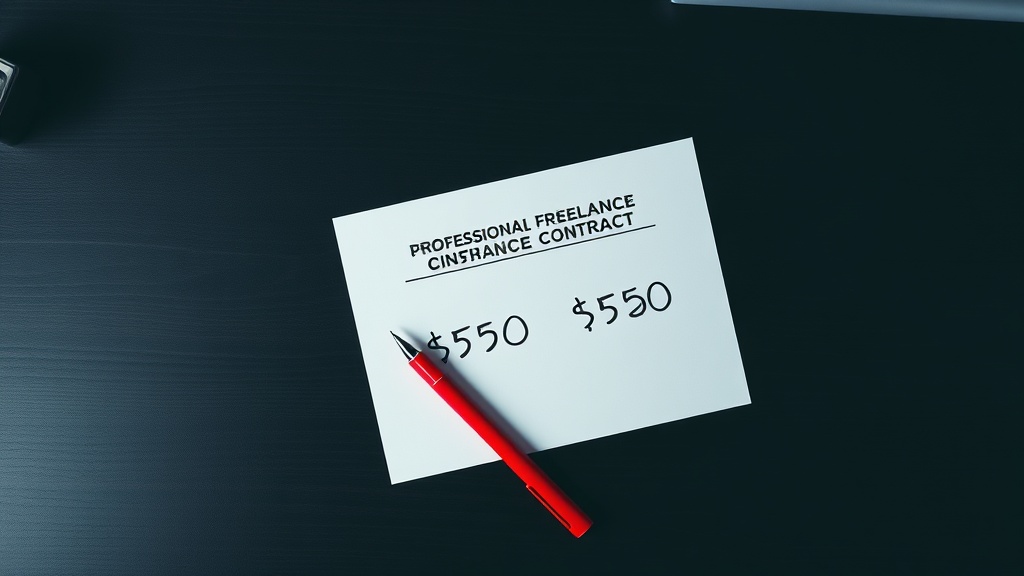
The Negotiation Flinch: Why Women Freelancers Leave $18K on the Table Every Year
International Women's Day is March 8th. You know what would be a better gift than a pink-branded LinkedIn post? Eighteen thousand dollars back in your pocket.
That's not a rounding error. While the broader gender pay gap in freelancing is real, what I'm talking about is different: a conservative composite of what a freelancer billing $60–80K leaves on the table annually through four specific negotiation patterns—not sexism they can't control, but behaviors they can. I'm going to name them exactly, put dollar figures on them, and give you systems that work before your next client call.
No inspiration required.
What the Research Actually Says
"Women earn 20% less" has become so abstract it doesn't move anyone anymore. Let's get specific.
The foundational research here is Linda Babcock and Sara Laschever's Women Don't Ask (2003), replicated consistently since: women are socialized to prioritize agreeableness in ways that create specific negotiation blindspots—accepting first offers at higher rates, countering less frequently, and absorbing expanded work without billing adjustment. This isn't freelance-specific data; it's salary negotiation research that compensation researchers and HBR have cited across professional contexts for two decades. The mechanisms—anchoring psychology, social penalties for assertive negotiation, conflict aversion around scope—translate directly to freelance client calls.
The social penalty piece is documented and real: women who negotiate assertively face harsher social perception penalties than men who do the same thing. That's not in your head. What's also documented: the penalty is smaller, in dollar terms, than the cost of not negotiating at all.
Now do the math with me.
A single instance of untracked scope creep—absorbing an extra revision round, a "quick call" that runs long, an add-on deliverable—on a $5K project costs roughly $1,250 in unbilled labor if it represents 25% overage. If that happens twice a month, you've given away $2,500 that month, $30,000 across a year. That's the scenario where scope creep is your only leak.
The $18K I'm putting in this headline is the blended conservative estimate across all four patterns below—first-offer acceptance without counter, untracked scope creep, absent rush fees, and the silence trap on discovery calls—for a freelancer doing $60–80K annually. Add them up conservatively and $18K is the floor. Some freelancers will recognize themselves in that number. Some will realize it's low.
That's not the pay gap. That's behavioral leak. And it's fixable.
The Four Patterns Draining Your Rate
1. The Silence Trap
You get on a discovery call. The client asks about your rate. You pause. They fill the silence with a number. You say yes or negotiate from their anchor.
This is the single most expensive silence in freelancing.
The research is clear: whoever names the first number anchors the negotiation. If you let clients anchor, you're negotiating from their floor, not your ceiling. I covered the minimum viable rate formula in a previous post—but knowing your number and saying it first are two different skills.
Annual cost estimate: $2,000–$4,000 depending on how often you take inbound calls without a stated rate.
2. Counter-Phobia
Client names a number. It's below your rate. You take it anyway because countering feels "difficult" or "greedy" or risks losing the engagement.
This is not a money problem. It's a reframe problem.
Your rate is a boundary, not a preference. When a client offers below your rate and you accept without counter, you haven't avoided conflict—you've just moved the conflict inside your own head for the next three months while you resent the engagement.
The rough math: if you're billing $60–80K across 8–10 projects per year, leaving 10% on each project because you didn't counter means $6,000–$8,000 annually. That's money that would have been there with a single sentence.
Annual cost estimate: $3,000–$8,000 depending on billing volume and how consistently you skip the counter.
3. The Scope Creep Absorption Tax
"Can you just add one more slide?"
"Actually, could we do three rounds of revisions instead of two?"
"We want to expand this to cover X, Y, Z—is that okay?"
The answer you give: "Sure, no problem."
The answer Future You gives: Why did I agree to that?
The tell is when you find yourself mentally justifying why you shouldn't charge rather than asking whether the work is in scope. That's the pattern. Conflict aversion around disappointing a client, combined with uncertainty about whether the add-on is "reasonable enough" to bill—both of those are learnable to override.
Annual cost estimate: $3,000–$8,000 depending on project volume and how often you absorb without a change order.
4. Rush Fee Avoidance
Client needs something in 48 hours. Your standard turnaround is a week. You say yes at your standard rate because you don't want to "nickel and dime."
Rush fees are not nickel-and-diming. Rush fees compensate for disrupted scheduling, weekend work, and the opportunity cost of deprioritizing other clients. Every freelancer—regardless of gender—should have a documented rush fee. It's one of the most consistently underused pricing levers in freelancing, and it fits the same pattern as counter-phobia: the discomfort of naming a premium feels more immediate than the cost of not naming it.
Standard rush fee: 25–50% premium on the project rate. If you're doing two rush projects a month without it, you're leaving $500–$1,500 on the table monthly.
Annual cost estimate: $6,000–$18,000 for anyone doing frequent turnaround-sensitive work.
The Counter System That Actually Works
This is the one move that recaptures the most ground fastest.
The formula:
- Let the client name their budget or offer first if they offer it.
- If they ask for your rate, give your number—don't ask what their budget is.
- When you receive an offer below your rate, counter at your rate + 20%.
- Then stop talking.
The silence after your counter is not awkward. It's the negotiation working. The client is processing. Do not fill it. Do not offer a discount preemptively. Do not apologize for the number.
Real script:
"Thanks for sharing that. Based on the scope we've discussed, my rate for this engagement is $X. I'd be glad to move forward at that number."
Then you wait.
The social penalty issue is real, and I'm not dismissing it. Women who negotiate assertively are perceived differently than men who do the same thing—this is documented across multiple studies. But the penalty decreases with repetition, and it is smaller, in dollar terms, than not negotiating. The first five times feel the worst. Build the rep over the long game.
Before Your Next Client Call: A Three-Step System
Most negotiation advice tells you what to do in the negotiation. That's backwards. By the time you're on the call, you've already won or lost.
Step 1: Write your scope limits down before the call.
Not in your head. On paper (or a doc). What's in scope? What triggers a change order? What's the maximum number of revision rounds? If you haven't named the edge of the project before the call, you'll agree to expand it during the call.
Step 2: Have your rate conversation in writing before the call.
Your rate page, a pre-call questionnaire, a project intake form—anything that puts your number in front of the client before you're in a live conversation. This removes the in-the-moment pressure to state your rate under social scrutiny.
Step 3: Pre-decide your walk-away number.
What's the minimum you'll accept for this project? Not a vague sense of "probably around X"—a specific number, written down. If the client doesn't reach your floor, you thank them and walk.
Most freelancers—not just women—don't have step three. That's where the flinch lives. When you haven't pre-committed to a walk-away, you make that decision in real time while a human being is watching you. That's when scope creep gets absorbed and counters get skipped.
The walk-away number isn't a threat. It's information. It tells you when to say yes and when to say "I don't think we're the right fit." Both are legitimate outcomes. (And if you're already in an engagement that needs to end, the client firing protocol has the step-by-step.)
The Timing Matters
Q2 client booking season starts now. March calls are where you set rates you'll live with through June. International Women's Day on March 8 will generate a lot of content about ambition and empowerment and breaking barriers.
None of that pays your taxes.
What pays your taxes is countering the next offer you get. Billing for the next scope expansion. Quoting a rush fee the next time someone needs something in 48 hours.
The gap isn't inspiration. It's systems.
Build the systems before the next call comes in.